Sabrina Carpenter has finally shared the real meaning behind her Man’s Best Friend album cover, after sparking debate across social media. The pop star revealed that the image — showing her kneeling while a man holds a strand of her hair — wasn’t meant to shock, but to symbolize emotional control and freedom. With confidence and humor, Carpenter explained that the concept reflects her personal growth and her refusal to apologize for her artistic expression
Sabrina Carpenter, one of pop’s most talked-about artists, has addressed the controversy surrounding the cover of her latest album, Man’s Best Friend. In a recent interview, the singer opened up about the inspiration behind the now-viral artwork — an image that sparked debate across social media — explaining that it was never about shock value, but rather a deeply personal reflection on power, control, and emotional freedom.
The cover, which shows Carpenter kneeling while a man holds a lock of her hair, drew criticism soon after its release. Some fans and critics labeled the image as “sexist” or “offensive to women,” while others praised it as bold and thought-provoking. But for Carpenter, the visual wasn’t meant to provoke outrage — it was about taking back her own narrative.
Speaking to Variety, the Espresso hitmaker said the concept stemmed from her personal experiences and relationships that made her feel emotionally pulled in multiple directions. She explained that the photo represents the invisible control and manipulation that women — and especially female artists — often experience. “The cover was about how people try to control women,” she shared. “For me, it was about feeling emotionally pulled in every direction. It was a way to show that I understand the power I gave away — and that I’m taking it back.”
Despite the backlash, Carpenter made it clear that she respects all interpretations of her work. “For some people, the image had weight. I understand that,” she said. “It just wasn’t meant as provocation. For me, it was emotional, not shocking. It meant one thing to me and a hundred to everyone else — and that’s okay.”
Her remarks reflect a growing maturity that has defined Carpenter’s evolution as an artist. Once known for her Disney beginnings, she has transformed into one of the most confident voices in modern pop, balancing humor, sensuality, and introspection with ease. The Man’s Best Friend album — which debuted at No. 1 on the Billboard 200 — solidified her as a true creative force, capable of pushing boundaries without losing authenticity.
The conversation around the album cover even caught the attention of industry veterans. Legendary singer-songwriter Carly Simon publicly supported Carpenter, saying, “She’s not doing anything extreme — she’s expressing her art the way every woman has the right to.” For Carpenter, this show of solidarity from a pioneering artist meant a lot. It reminded her that conversations about women’s autonomy in music are far from over — they just keep evolving with each generation.
Carpenter has often said that her biggest inspirations were women who dared to sing about love, power, and desire without fear. “When I was younger, I listened to women who owned their emotions,” she said. “I remember thinking, ‘When I grow up, I want to embrace that side of myself too.’”
That self-awareness is evident not only in her lyrics but also in the way she handles criticism. When a user on X (formerly Twitter) mocked her by writing, “Does she have a personality beyond sex?”, Carpenter delivered a quick and iconic reply: “Girl yes — and it is goooooood.” The post went viral within hours, celebrated by fans as the perfect blend of sass and self-confidence.
In the interview, Carpenter reflected on how she balances being playful and provocative with staying grounded. “People think I’ll say or do anything, but I have boundaries. You’d be surprised!” she laughed. “I’m just living my life, and people are watching. If they enjoy it, great. If not, it’s not for them.”
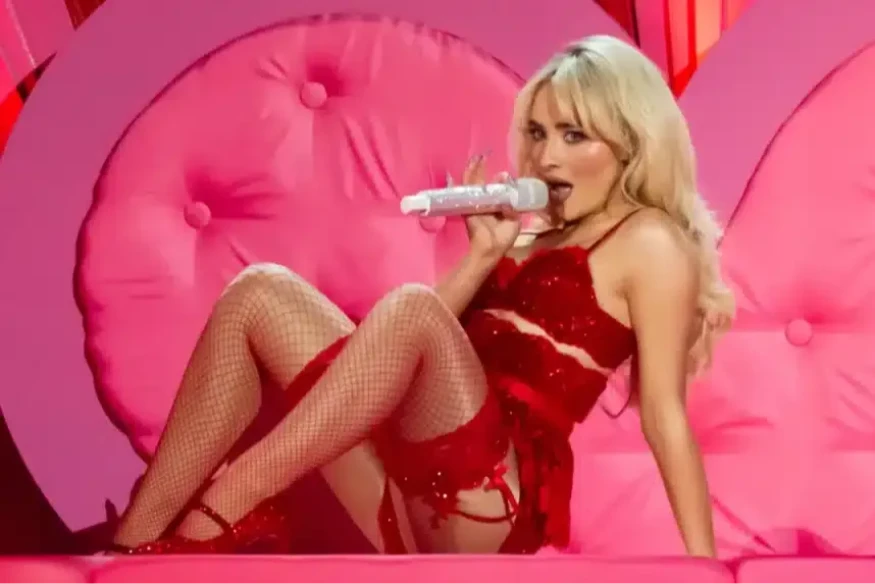
That mindset — unapologetic yet self-aware — has become her signature. Whether performing live, starring in music videos, or gracing magazine covers, Carpenter radiates the confidence of an artist who knows exactly who she is. Her performances exude energy, humor, and charm, yet she never loses the emotional core that defines her artistry.
Man’s Best Friend reflects that balance perfectly. It’s playful but sincere, sexy yet vulnerable, commercial but deeply introspective. The lyrics explore themes of love, control, independence, and emotional release, showing Carpenter as both storyteller and protagonist of her own narrative. For her, the album art wasn’t about creating controversy — it was about visualizing that same inner dialogue.
“The people in your life can pull at you in ways you don’t even notice,” she explained. “Some pull on your emotions, others on your energy. For me, the cover was about acknowledging that — and letting go.”
The album’s imagery, paired with its sonic storytelling, captures the tension between submission and empowerment — a recurring theme in Carpenter’s recent work. Far from being a publicity stunt, it’s a commentary on the expectations women face in the music industry and beyond.
As for how she feels now, Carpenter seems unfazed. She has learned to use controversy as fuel for creativity rather than conflict. Her approach to fame and criticism is refreshingly calm, marked by humor and authenticity. “I don’t think about it too much,” she said. “People will always project their own meaning onto your art. My job is to make something that feels honest.”
Carpenter’s career trajectory speaks for itself. With every album, every tour, every viral moment, she challenges the stereotypes of what a pop star should be. Her rise from teen actress to pop powerhouse has been marked not just by catchy hits, but by genuine artistic growth.
And perhaps that’s what makes her story so compelling. She doesn’t try to please everyone — she just keeps evolving. Her music, her visuals, and her confidence all point to one message: power comes from authenticity.
In a world quick to label women’s art as “provocative,” Sabrina Carpenter continues to prove that self-expression isn’t rebellion — it’s freedom. Whether she’s teasing a new single, performing to sold-out crowds, or standing her ground in an interview, one thing is clear: she’s not asking for approval. She’s simply creating on her own terms — and that’s exactly why she stands out.