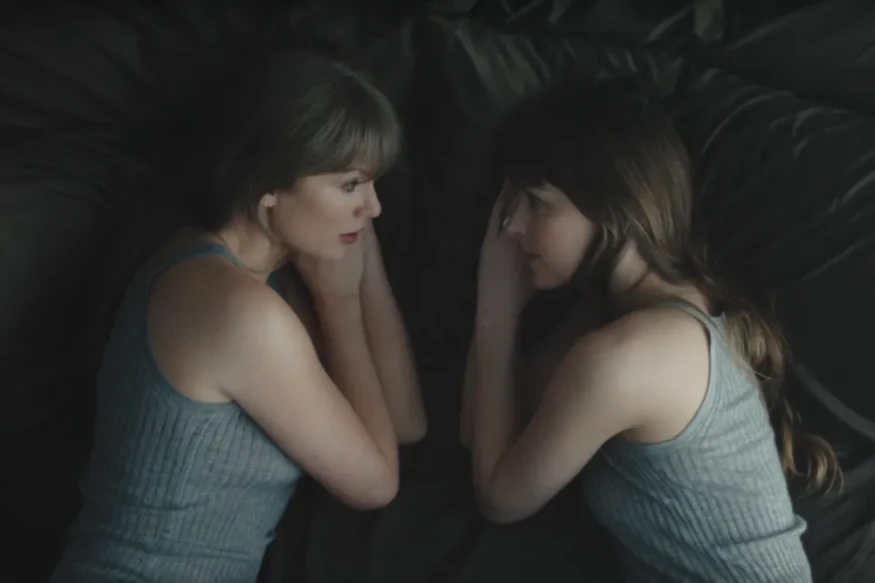
Taylor Swift turns a $46.95 million Beverly Hills mansion into a key part of the dark story behind her “Patient Zero” music video. Starring Dakota Johnson and Colin Farrell, the cinematic clip uses the home’s Brutalist design, glass walls and huge open spaces to reflect a toxic relationship, while Swift connects the setting to gothic stories, psychological thrillers and the emotional coldness at the center of the song.
Taylor Swift turned a Beverly Hills mansion into one of the most important characters in her “Patient Zero” music video, using the $46.95 million home to mirror the emotional distance at the center of the story. The 18,344-square-foot property, with its sharp Brutalist design, glass walls and sweeping views, became the perfect backdrop for a dark love story starring Swift, Dakota Johnson and Colin Farrell.
The “Patient Zero” video premiered during the 2026 MTV Video Music Awards on September 27, giving Taylor Swift another major visual moment built around more than just performance. This time, the setting carries much of the mood. Rather than using a warm or romantic home, Swift chose a dramatic Beverly Hills estate that feels beautiful, expensive and emotionally cold, matching the story she wanted to tell.
Taylor Swift explained that the house represented the chill of a relationship that had slowly lost its life. That idea runs through the entire video. The mansion is polished and impressive, but it also feels distant and almost empty, creating a space where the characters can look close physically while feeling completely disconnected emotionally.
For Taylor Swift, the home itself is hard to ignore. It includes five bedrooms, nine bathrooms and more than 18,000 square feet of interior space. Designed by ID Group, the property mixes huge open rooms with strong concrete shapes, dramatic glass and clean lines. It recently sold in June 2026 for $46.95 million, making it as much a luxury real estate story as a pop culture location.
For Taylor Swift, the house was not simply a glamorous place to shoot. Its design had a clear purpose inside the story. The video follows a toxic relationship and the emotional damage left behind, and the mansion gives that tension a physical form. The cool surfaces, oversized rooms and sharp architecture make the relationship feel even more distant as the story moves forward.
One of the most memorable spaces is the main living area, where a retractable glass wall opens toward the infinity-edge pool and city views. In one scene, Taylor Swift, Dakota Johnson and Colin Farrell stand almost like statues, turning the room into something closer to a gallery than a home. The beauty of the setting makes the emotional discomfort even stronger.
The mansion also includes a circular motor court that helps shape the interior in an unusual way. That detail becomes especially visible during a scene where Johnson’s character reaches for a stone wall as she begins to feel unwell. The architecture is not just in the background. It affects how the characters move and how the tension is shown on screen.
Colin Farrell appears as the toxic former partner at the center of the story, while Taylor Swift and Dakota Johnson move through similar emotional experiences. Their characters repeatedly mirror each other, from the clothes they wear to the way they react. That visual connection makes the story feel less like one person’s breakup and more like a pattern repeating itself.
As the relationship falls apart, Taylor Swift uses the mansion to make that sense of repetition feel even colder. The home is huge, yet the characters often seem trapped inside it. Large rooms do not create freedom here. They create distance. The more beautiful the surroundings become, the more uncomfortable the emotional mood feels.
That contrast is one of the strongest ideas in the “Patient Zero” music video. Luxury usually suggests comfort, success and escape, but Taylor Swift flips that idea. The expensive Beverly Hills mansion becomes a place where love has already started to disappear. It looks perfect from the outside while everything inside the relationship feels damaged.
The visual approach also fits the darker style Taylor Swift wanted for the project. She said the video gave her a chance to explore cinematic and literary worlds she has long loved. Instead of building the story around one simple pop video idea, she mixed elements of gothic ghost stories, true crime and psychological thrillers into one carefully controlled setting.
That combination gives “Patient Zero” a different feel from many of Taylor Swift’s earlier videos. There are still strong fashion moments, star casting and carefully planned visuals, but the tone is more like a short film. The mansion helps support that shift because every room can feel like its own scene, with shadows, glass, stone and empty space changing the mood from one moment to the next.
Taylor Swift has also pointed to literary inspiration behind the project. The story appears to carry echoes of Daphne du Maurier’s “Rebecca,” a book Swift previously named as a favorite. That influence makes sense in a video built around a beautiful home, emotional unease, memory and the feeling that something is wrong even when everything looks elegant.
The house becomes even more effective because it does not look traditionally gothic. There are no old castles, dark wooden halls or antique rooms. Instead, Taylor Swift places gothic emotion inside a modern Beverly Hills mansion. The fear and sadness come from clean design, silence and scale, giving the story a more current and stylish edge.
That choice also makes the video more connected to modern celebrity culture. A mansion worth nearly $47 million instantly brings glamour and curiosity, but “Patient Zero” uses that luxury as part of the emotional problem. The setting looks like a dream property, yet the characters inside it are moving through jealousy, pain and a relationship that has clearly lost its warmth.
For fans who enjoy looking for meaning in every Taylor Swift detail, the mansion adds another layer. The glass walls can suggest exposure, the wide empty spaces can suggest isolation, and the pool and city views can make the characters look surrounded by beauty while still emotionally cut off. None of those details need to be explained directly for the mood to work.
The casting strengthens that feeling. Dakota Johnson brings a calm, controlled presence that matches the mansion’s cold design, while Colin Farrell gives the story a darker edge. Taylor Swift moves between performer and storyteller, using her character to connect the song’s emotional tension with the visual world around it.
The video also shows how carefully Taylor Swift now treats location as part of the narrative. A house this expensive could easily have been used only for visual impact, but here it becomes part of the meaning. The rooms, walls and open spaces all support the idea of a relationship that still looks impressive from the outside while falling apart underneath.
Even the property’s recent sale adds to the fascination around Taylor Swift’s video. The Beverly Hills estate changed hands for $46.95 million only a few months before the “Patient Zero” premiere, giving fans a real-world detail to connect with the fictional story. It is a rare mix of celebrity real estate, music video production and high-fashion pop storytelling.
For Taylor Swift, “Patient Zero” becomes a project where the setting says almost as much as the lyrics and performances. The mansion does not soften the story or make it feel romantic. It does the opposite, giving the video a hard, distant mood that keeps building as the relationship breaks down.
By placing a tragic relationship inside one of Beverly Hills’ most striking modern homes, Taylor Swift creates a visual world where wealth, beauty and emotional emptiness exist side by side. The result is a music video that turns a luxury mansion into more than a backdrop, using every cold surface and open room to deepen the atmosphere around “Patient Zero.”